
Train the Trainer: How to Build a Program That Scales
Train the trainer turns experts into instructors so training scales. The model, how to design a program, best practices, and how certification works.
Train the trainer is a model for teaching subject-matter experts not just what to teach but how to teach it, so an organization can multiply its instructor capacity instead of relying on a handful of people or repeatedly hiring outside experts. A small group learns the content and the craft of facilitation, then delivers that training to everyone else.
For the businesses that deliver training for a living, and the L&D teams that run it in-house, train the trainer is one of the highest-leverage moves available: it turns a delivery bottleneck into a repeatable system. This guide explains what train the trainer means, how the model works, how to design a program, the best practices that separate the ones that work from the ones that don't, and how to run it at scale.
Key takeaways
- Train the trainer (TTT) turns experts into instructors. It develops both subject knowledge and facilitation skill, so the people who know the material can teach it well.
- It exists to solve a capacity problem. When demand for training outruns the number of qualified instructors, TTT multiplies delivery capacity without proportionally multiplying headcount.
- The model is design → develop → deliver. Effective programs cover instructional design, materials, and live facilitation, plus practice, assessment, and ongoing support.
- The hard part is rarely the curriculum; it's the operations. Consistency, instructor matching, scheduling, and tracking are what determine whether a trainer bench actually scales or quietly drifts.
What is train the trainer?
Train the trainer (often abbreviated TTT) is a framework for preparing potential instructors (usually subject-matter experts) to teach a subject to others.Participants receive a focused program that covers two things at once: the specific content they'll deliver, and the skills required to deliver it well, such as adult learning principles, facilitation technique, and presentation skills.
The defining idea is the multiplier effect. Instead of one expert teaching every session forever, you teach a group of people to teach, and each of them can then run sessions on their own. One investment in a handful of trainers becomes ongoing delivery capacity across the whole organization.
In short: a regular course teaches people a skill. A train-the-trainer course teaches people how to teach that skill to others.
What is the train-the-trainer (cascade) model?
The train-the-trainer model is sometimes called the cascade model, because expertise cascades outward in waves. A group of “master trainers” is trained on a topic; they each train smaller groups; those groups can train others; and so on, until everyone who needs the training has it.
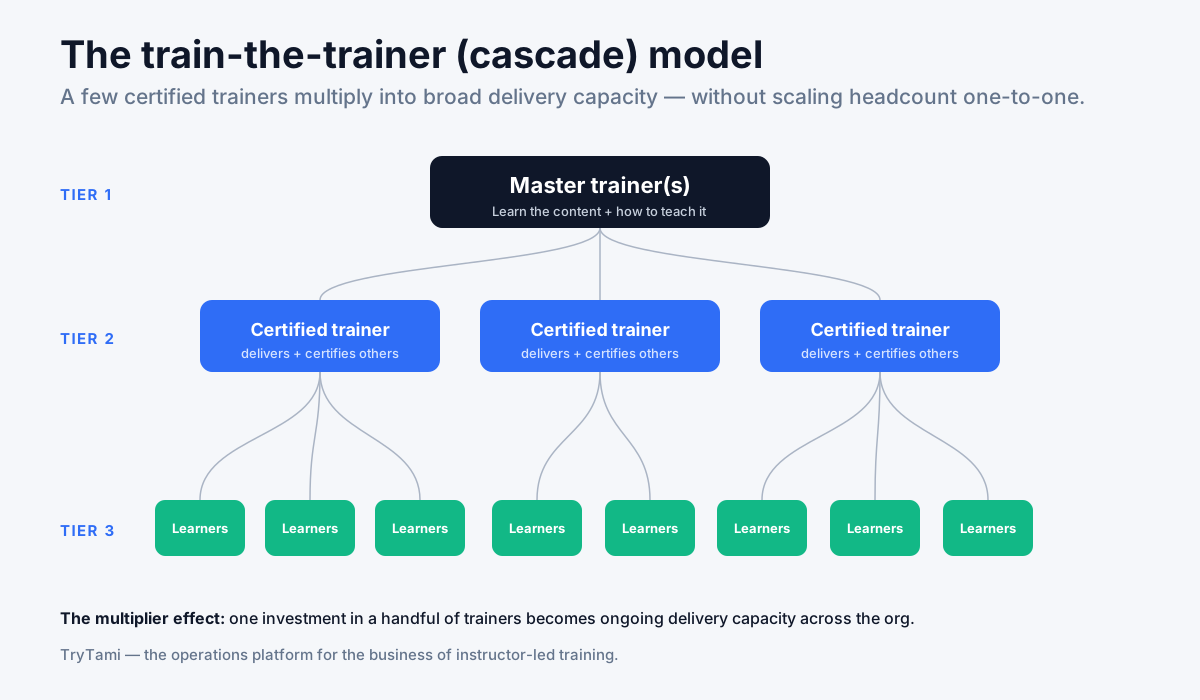
The cascade model is how large organizations train thousands of people efficiently: onboarding a global workforce, rolling out a new system, or standardizing a compliance procedure across regions. Rather than flying one expert to forty offices, you certify trainers in each location and let the knowledge spread locally.
The trade-off to manage is dilution: every time content passes from one layer to the next, quality and fidelity can erode if the materials, standards, and support aren't strong. The whole art of running a cascade well is keeping the message consistent as it travels.
Why use a train-the-trainer program?
Train the trainer earns its place because it fixes a problem almost every growing training operation eventually hits: there are never enough good instructors.
- It multiplies capacity. A few trained facilitators can cover far more sessions, regions, and cohorts than a single expert ever could.
- It's cost-effective at scale. Building an internal trainer bench is typically cheaper over time than paying an outside expert to deliver the same content again and again. An in-house system also absorbs turnover: when a trainer leaves, you certify another instead of starting over.
- It drives consistency. When trainers are developed from a shared program with shared materials, every cohort gets a comparable experience.
- It builds institutional knowledge. Internal trainers understand your context, your customers, and your systems in a way a parachuted-in contractor can't.
- It addresses the instructor shortage. In a market where demand for live, expert-led training keeps rising, the constraint is rarely content; it's qualified humans who can teach it. TTT manufactures more of them.
For a training business specifically, that last point is the whole game. Your ability to say yes to a client who wants a program rolled out across five regions next quarter depends entirely on whether you can field the instructors to deliver it.
How to design a train-the-trainer program
Most effective train-the-trainer programs are built around three components: design, development, and delivery.
1. Design: start from outcomes. Define what a successful trainer should be able to do by the end, and structure the program backward from there. Cover the fundamentals of how adults learn, basic instructional design, and how the specific content is meant to land.
2. Develop: give trainers the materials. Trainers shouldn't have to invent their own slides, guides, and exercises. Provide a facilitator guide, participant materials, job aids, and a clear run-of-show. Strong, standardized materials are the single biggest defense against the dilution problem in a cascade.
3. Deliver: train the craft, not just the content. Delivery is where most programs underinvest. Voice, pacing, body language, eye contact, handling questions, managing a room (or a virtual room), and reading engagement are all teachable skills. Give participants real reps.
Around those three, the programs that actually work add four things:
- Pick the right people. Look for strong communication and interpersonal skills, genuine subject-matter expertise, and, crucially, a desire to teach. Expertise without the will to facilitate doesn't make a trainer.
- Make it hands-on. Blend theory with practice: discussion, role-play, simulation, and live “teach-backs” where participants deliver a segment and get coached on it.
- Assess before and after. Test knowledge and facilitation skill going in and coming out, and build a way to measure how well the training those new trainers deliver actually performs.
- Support them after certification. Follow up, identify where new trainers need help, and refresh the course content annually so it doesn't go stale.
How train-the-trainer certification works
A train-the-trainer certification confirms that someone can actually deliver a program on their own, not just that they sat through one. The strongest programs require three things before clearing a trainer for solo delivery: completion of the content itself, a demonstration of facilitation skill (usually a graded teach-back in front of the master trainers), and sign-off against a competency checklist. Certification should also expire: content changes, skills drift, and periodic recertification is what keeps a cascade honest. Operationally, that means tracking who is certified in what, when each certification lapses, and blocking assignment of uncertified trainers, which is a certification tracking job, not a spreadsheet column.
Train-the-trainer best practices
The difference between a program that scales and one that fizzles usually comes down to a handful of disciplines:
- Standardize the materials, not the personality. Give every trainer the same guide and assets so the content is consistent, but let them facilitate in their own authentic style.
- Certify, don't just attend. A trainer should have to demonstrate competence (a graded teach-back, a checklist) before they're cleared to deliver solo. Attendance is not certification.
- Watch the cascade for drift. The further content travels from the master trainers, the more quality can erode. Audit downstream sessions and refresh certification periodically.
- Measure the downstream, not just the room. The point of TTT isn't trainer satisfaction; it's the performance of the people they go on to train. Track that.
- Treat the trainer bench as an asset to manage. Who's certified in what, who's available, who's due for recertification, who's overloaded. This is operational data, and it decays fast in a spreadsheet.
That last practice is where good programs quietly break. You can run a brilliant train-the-trainer course and still fail to scale, because nobody can answer “who can teach this, and are they free next Tuesday?” without an afternoon of emails.
The hard part isn't the training; it's running the bench
Train the trainer solves the capacity problem on paper. But the moment you have a roster of certified trainers instead of one expert, you've created an operations problem: matching the right trainer to each session, scheduling across availability and time zones, tracking certifications and recertification dates, keeping materials current, and reporting on what was delivered and how well.
For a training business, this is the coordination work that scales linearly with volume: every new trainer and every new client adds another calendar, another spreadsheet, another email thread. The capacity you worked so hard to build gets eaten by the admin required to deploy it.
This is exactly the gap instructor-led training operations software is built to close. A purpose-built system keeps your trainer bench (skills, certifications, availability, utilization) as live, connected records, so matching the right instructor to a session takes seconds instead of an afternoon, scheduling doesn't require a spreadsheet, and you can see at a glance who's certified, who's available, and what's been delivered.
Train the trainer isn't a delivery format the way instructor-led training or blended learningare; it's the engine that supplies those formats with qualified instructors. The training organizations winning right now aren't the ones with a single star instructor. They're the ones who turned that person's expertise into a repeatable program, and built the operational backbone to deploy a whole bench of trainers without drowning in coordination.
Sources
- SessionLab, What is the train-the-trainer model?
- Training Industry, How to Create a Train-the-Trainer Program That Actually Works
- TrainSmart, Train-the-Trainer Best Practices for Corporate Trainers
- British Council, Train the Trainers & Cascade Models — A practical guide and toolkit
- The Mandatory Training Group, Cost effectiveness of the train the trainer model
Written by Kelby Zorgdrager. TryTami is training management software for instructor-led and blended programs. Choosing a platform? Start with our guide to the best training management software in 2026.
See what this looks like without the spreadsheet.
TryTami runs the scheduling, instructors, and logistics behind instructor-led training — automatically.
Frequently asked questions
What does train the trainer mean?
Train the trainer (TTT) is a model for teaching subject-matter experts how to teach, developing both their content knowledge and their facilitation skills so they can deliver training to others. The goal is a multiplier effect: train a few people to train many.
What is the train-the-trainer model?
It is a cascade approach to scaling training. A group of master trainers is trained on a topic, and they in turn train smaller groups, who can train others, until everyone who needs the training has received it.
What's the difference between a course and a train-the-trainer course?
A regular course teaches you a skill. A train-the-trainer course teaches you how to teach that skill to others, adding instructional design, facilitation technique, and presentation skills on top of the subject content.
How do you design a train-the-trainer program?
Build it around design (instructional structure and adult-learning fundamentals), development (facilitator guides and materials), and delivery (live facilitation craft). Add careful participant selection, hands-on practice and teach-backs, before-and-after assessment, and ongoing support after certification.
Is the train-the-trainer model cost-effective?
Generally yes, at scale. Developing an internal trainer bench is usually cheaper over time than repeatedly paying outside experts to deliver the same content, and it absorbs staff turnover because you can certify new trainers as people leave.
What is a train-the-trainer certification?
A train-the-trainer certification confirms that someone has demonstrated both the subject knowledge and the facilitation competence to deliver a program on their own. The strongest programs require a graded teach-back rather than just attendance before certifying a trainer to deliver solo.
How do you scale a train-the-trainer program?
By managing the trainer bench as an operational asset: track who is certified in what, who is available, and who is due for recertification; match the right trainer to each session; standardize materials to prevent quality drift; and connect scheduling, delivery, and reporting so adding trainers and clients does not add proportional admin.
Keep reading
Software for training companies
Go deeper on the platform built for this.
The Best Online Learning Platforms for Training Teams (2026)
A practical guide to the best online learning platforms: what each is good at, who they fit, and how to choose for instructor-led and blended programs.
How Much Does Training Management Software Cost?
Training management software costs $300–$3,000+/mo depending on trainers, sessions, and tier. The pricing models, hidden costs, and how to judge ROI.
Cut the busywork. Grow your training business.
TryTami is the training management software that automates the coordination behind instructor-led training. Request a 30-minute demo with the founders.