The operations platform for corporate training providers and training companies.
TryTami simplifies the operations behind every training program. Run more sessions, deliver them better, and keep more of every dollar you earn. The operations platform for profitable training businesses.
What is software for corporate training providers?
Software for corporate training providers, often called a training management system (TMS), runs the operational stack of a commercial training business: course catalog, instructor network, proposals, scheduling, billing, and reporting on a single platform. It is what corporate training companies use to run more programs, more efficiently, and protect margin.
Unlike generic project management or LMS tools, a purpose-built training-company platform like TryTami treats courses, instructors, clients, and revenue as first-class objects, so the way you sell, deliver, and bill training all live in one system. See how this maps to the broader training management software category.
Every new client adds a spreadsheet, a calendar invite, and a hire.
Commercial training companies hit an ops ceiling fast. The system that worked at 5 clients breaks at 50. The only knob you have left is hiring, until margin disappears.
Tool sprawl is the system
Bookings in a spreadsheet. Schedule in Google Calendar. Proposals in PDF. Invoices in Stripe. The 'system of record' is whoever's most awake.
Trainer scheduling eats the day
You spend hours emailing instructors to confirm availability, then more hours rescheduling when one drops. AI matching saves it all.
More clients = more coordinators
The only path to growth is hiring. Margin gets eaten by overhead instead of falling to the bottom line where founders need it.
Public + private = double the chaos
Running both open-enrollment and dedicated B2B engagements multiplies the operational load without proportional tooling.
Why training companies choose TryTami
Built for the business of selling training, not just delivering it.
Other platforms treat training delivery like an afterthought to a learner experience. TryTami flips it: the training company is the customer.
Sell faster with a real proposal pipeline
Move every deal through Submitted → Designing → Search → Pick Trainer with named stages, win/loss tracking, and zero email-thread archaeology.
Scale your instructor network
Manage in-house W-2s, 1099 contractors, and licensed partners as one network. Track availability, skills, certifications, and what's owed, automatically.
AI instructor matching
TryTami's matching engine picks the best-fit instructor for each session based on availability, skills, and other factors, replacing hours of manual coordination per booking.
Public + private + on-site in one catalog
Run open-enrollment courses, dedicated B2B engagements, and on-site delivery from one course catalog with one revenue dashboard.
Revenue is a first-class object
Booked, dedicated, public-course, owed-to-trainers, every metric your CFO and your accountant actually need, surfaced live.
Operations intelligence
Know which courses are profitable, which instructors are over-booked, and which clients are slipping, before it shows up in the P&L.
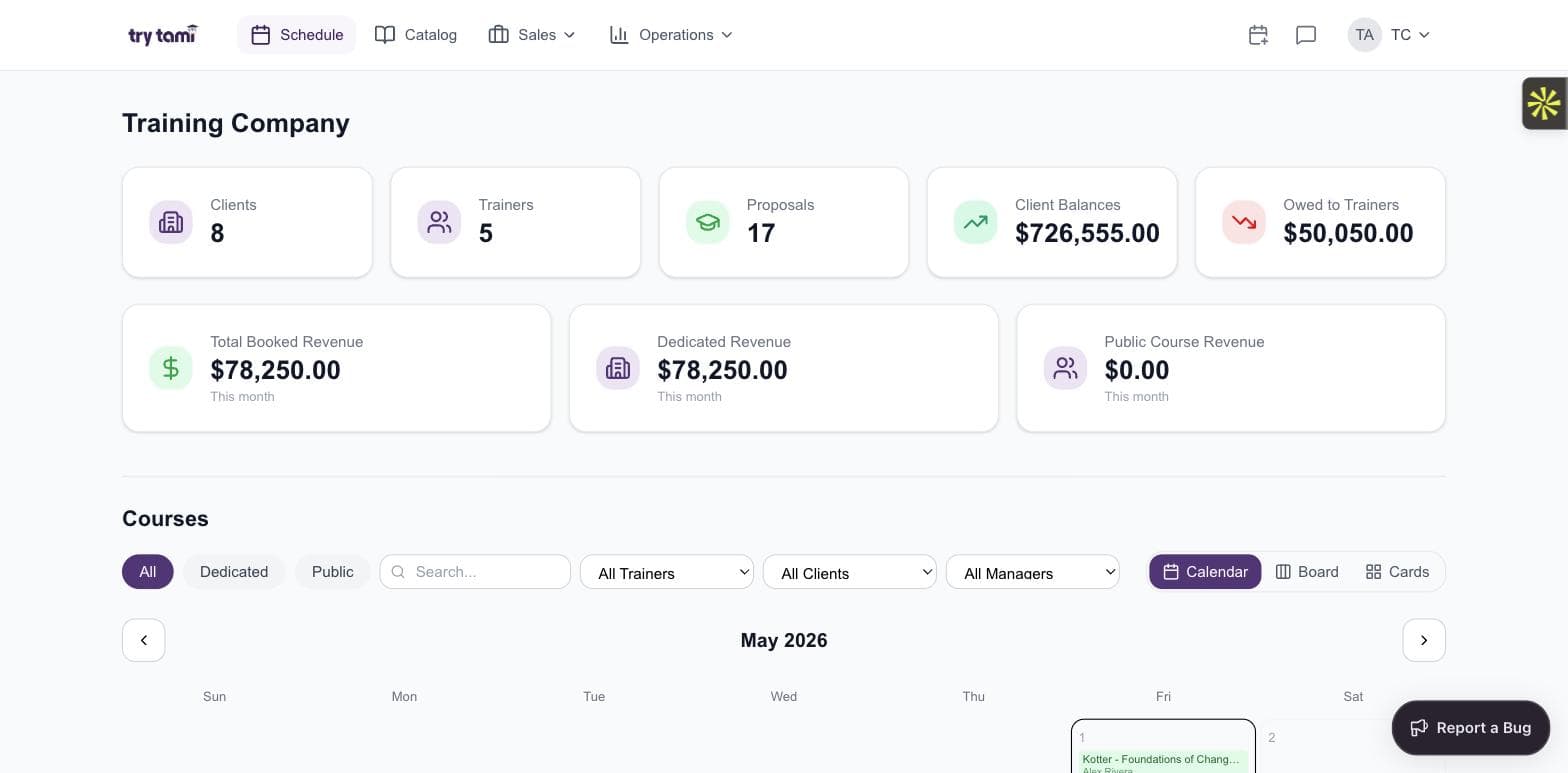
Schedule
Every session, every client, every instructor, one screen.
The chaos of running a multi-client training company is invisible to your tools but obvious to your team. TryTami makes it visible.
- Calendar, board, and card views across all clients
- Filter by instructor, client, or program manager
- Public, dedicated, and on-site courses in one place
- Instructor availability + utilization layered in
Proposals
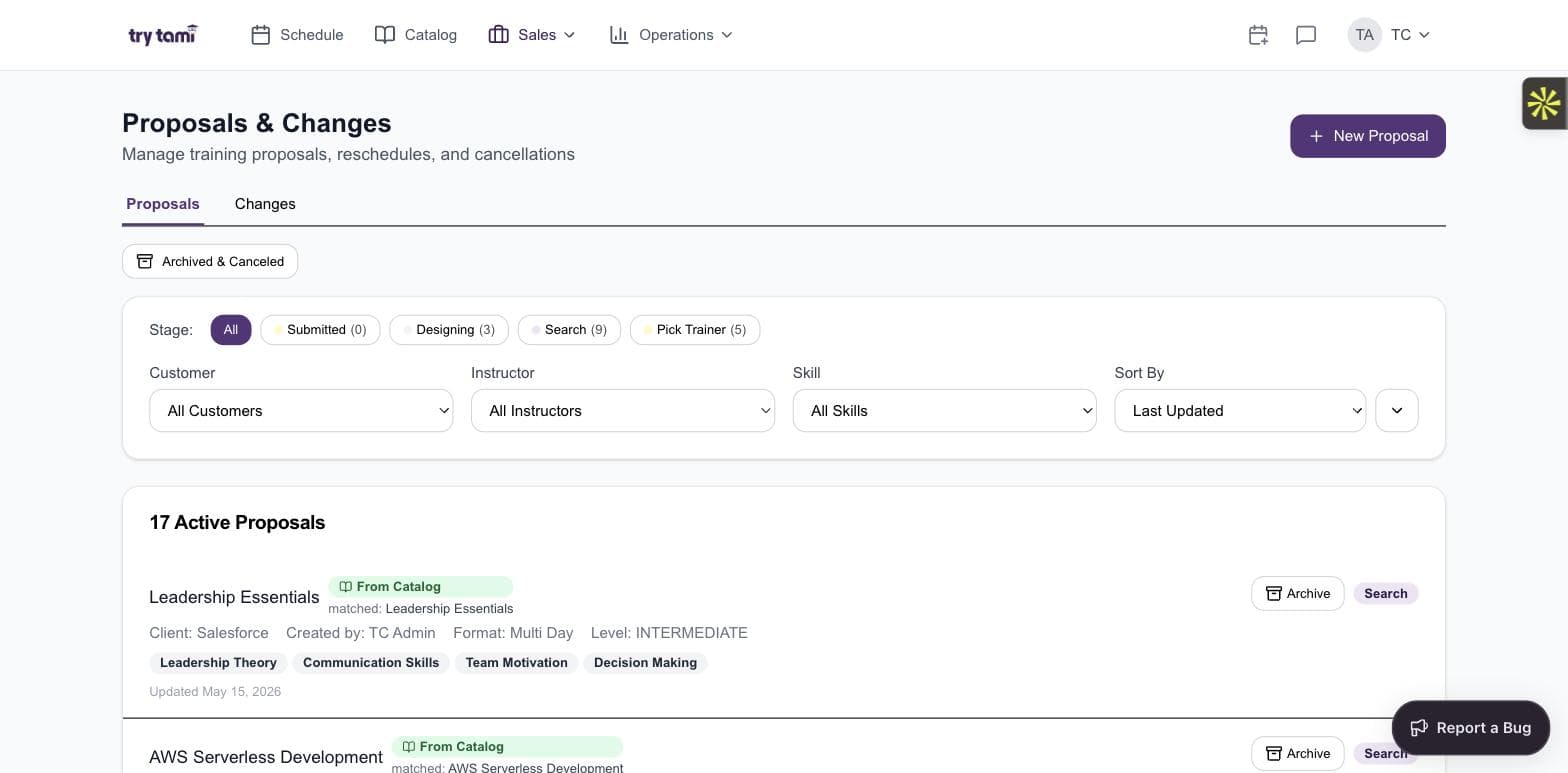
Move every deal through a real pipeline.
If your sales process lives in Gmail and a Google Doc, you're losing deals you don't even know about. TryTami gives you a proposal pipeline that closes the loop.
- Stage-based pipeline: Submitted → Designing → Search → Pick Trainer
- Filter by customer, instructor, skill, manager
- Archive and cancel without losing the data
- Win/loss reporting baked in
The math
What the status quo costs a training company.
Most commercial training providers leak revenue to manual coordination and lost deals. Here is what that looks like before vs after TryTami.
Baseline: Mid-size training company, 5 trainers, ~25 sessions per month.
$250K/yr
$21.6K/yr
$228K/yr
Payback in 35 days
Your numbers will be different. Run the calculator with your team size, session count, and current admin spend.
Run your own numbers →Stop hiring coordinators every quarter.
See how training companies use TryTami to run 3× the sessions with the same team.
Instructors
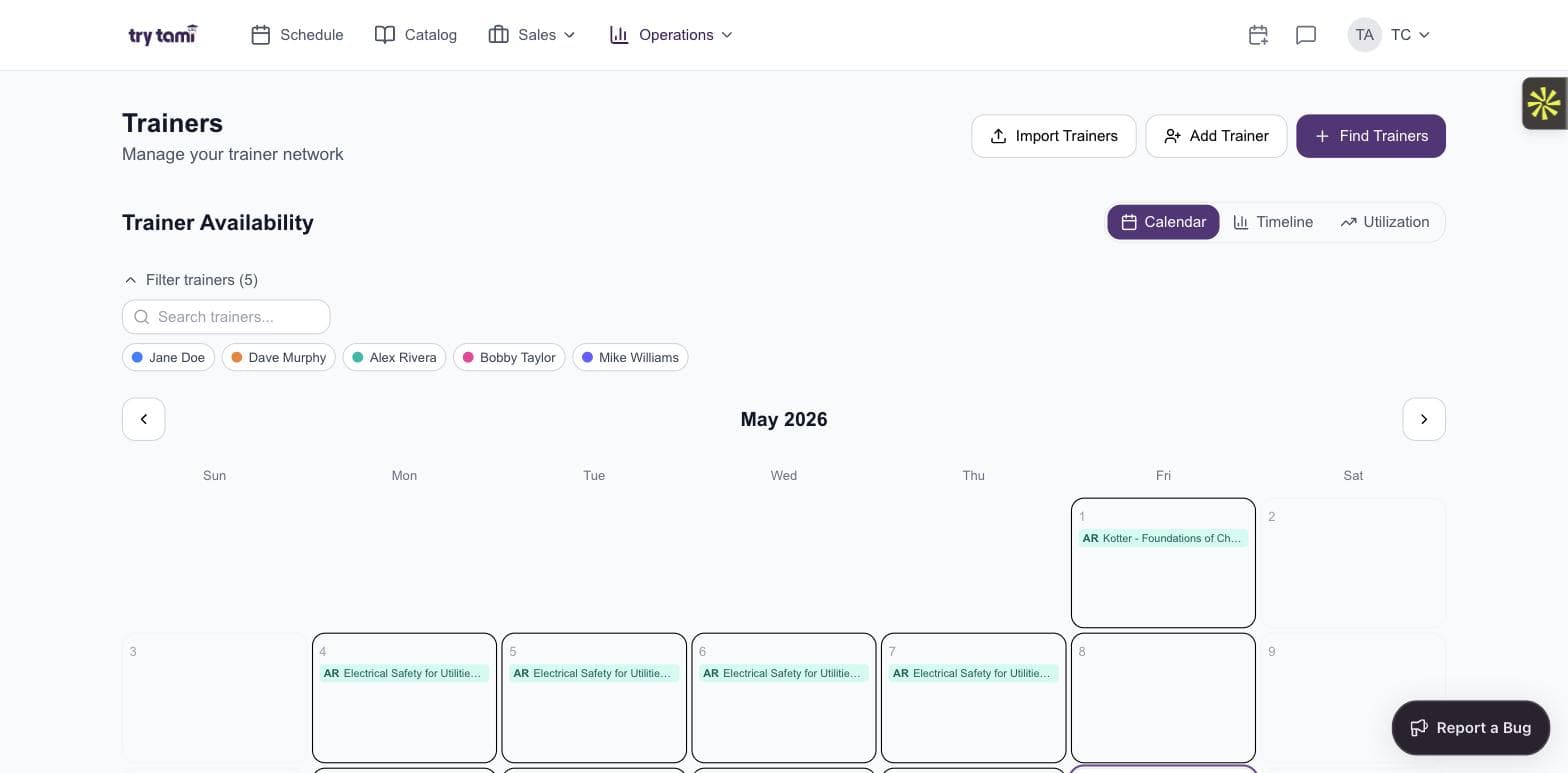
A training network you can actually run.
Whether your delivery team is five people or five hundred, TryTami treats trainers as a first-class resource, with availability, utilization, and skill-matching built in.
- Calendar, timeline, and utilization views
- Filter by instructor or skill
- Add, import, or recruit instructors from one place
- Track what's owed to each instructor per session
AI matching
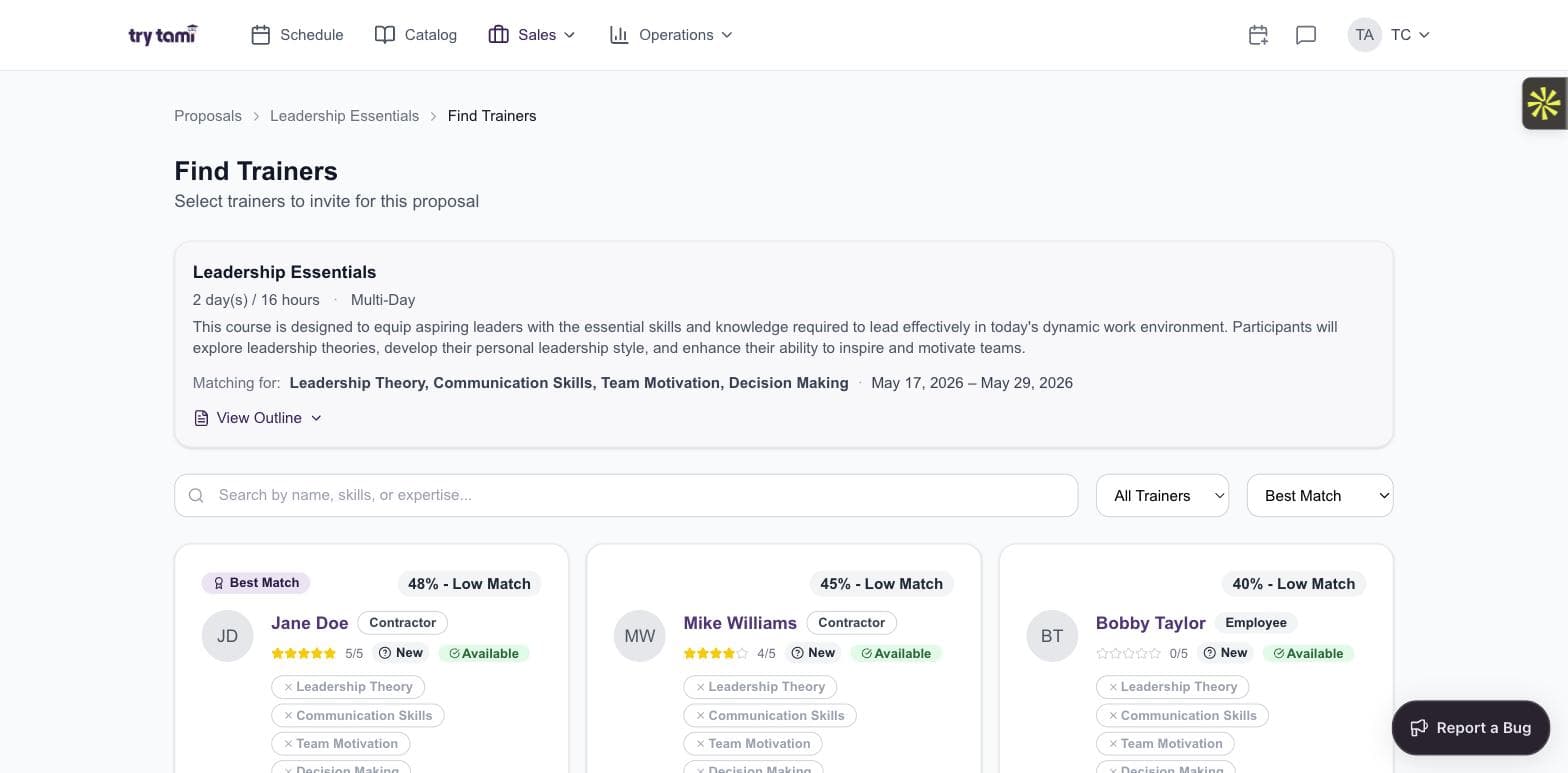
The right trainer, ranked in seconds, not emailed in hours.
Stop emailing the network. TryTami scores every qualified trainer on availability, skills, location, and history, and surfaces a ranked shortlist for every session.
- Match score per trainer based on real factors
- Filter by skill, availability, contractor vs employee
- Invite the shortlist in one click
- Replaces hours of coordination per booking
Customer portal
Your customers get a branded portal, not an email thread.
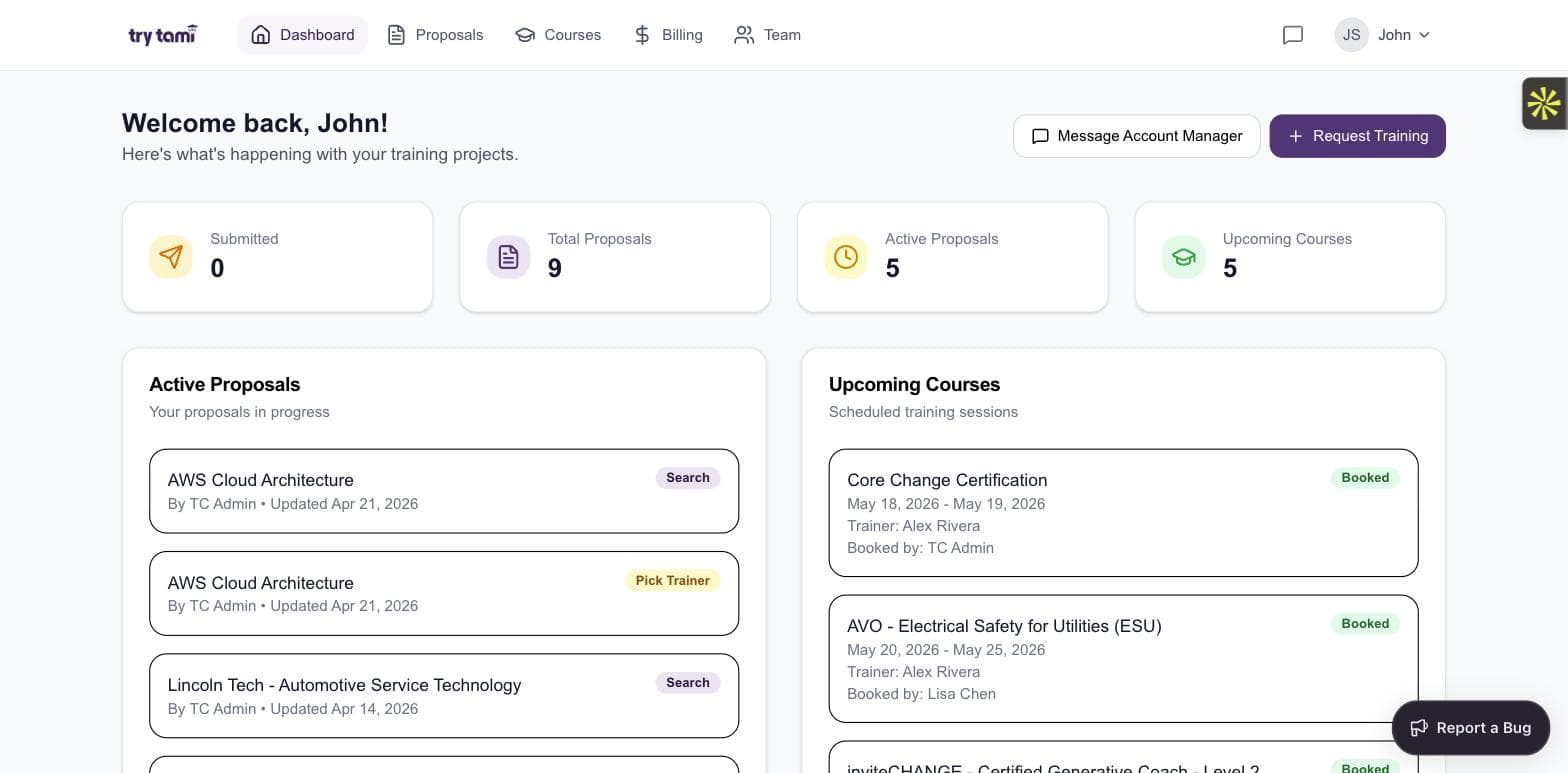
Self-service registration, proposal status, course calendars, billing transparency. Your customers run themselves so your team can run more sessions.
- White-labeled customer dashboard
- Self-service course registration + team management
- Real-time proposal status (no more 'where are we on this?')
- PO-backed billing your customers can audit themselves
Instructor portal
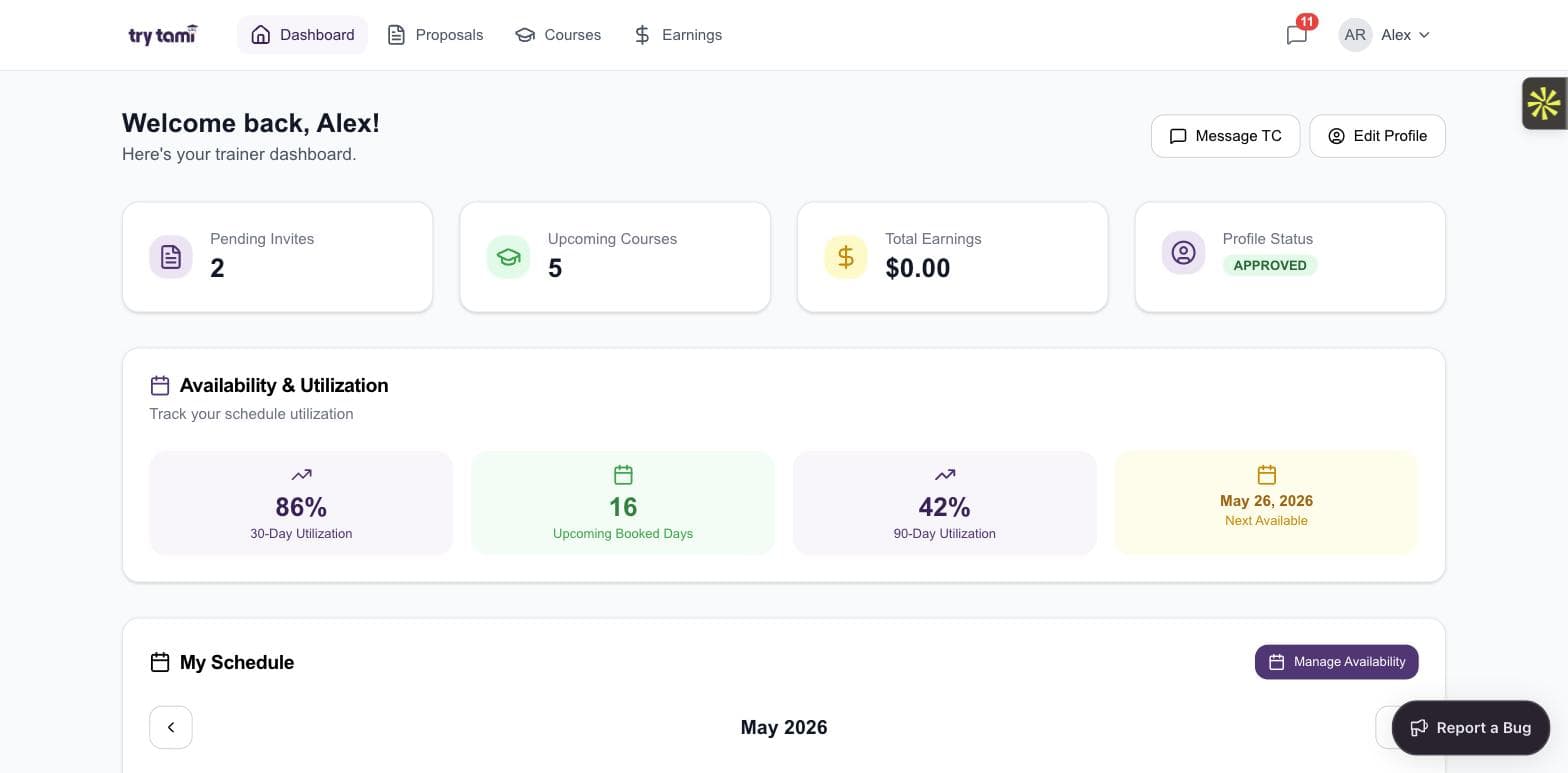
Your trainers get the same modern experience.
Instructors see their schedule, their proposals, their earnings, their utilization. Less friction means better trainers stay with you longer.
- Real-time schedule + course details
- Accept or decline proposals in-app
- Live earnings + utilization tracking
- Direct chat with the training company
Built by founders who've run a training company.
We've run a training business. The hardest part wasn't the training. It was the operations behind it. We built TryTami to simplify that work, run more programs, and improve your bottom line on every engagement.
What's the best software for a training company?
The best training-company software is a purpose-built TMS that handles your full delivery lifecycle, catalog, scheduling, instructor management, proposals, billing, and reporting, without you stitching together a CRM, calendar, LMS, and accounting tool.
See our guide to choosing the best training management software for criteria, weights, and head-to-head competitor comparisons.
Frequently asked questions
How is TryTami different from a generic LMS?
An LMS is built for the learner, content delivery, completions, certifications. TryTami is built for the training business, scheduling, instructor management, proposals, revenue. Most training companies need both, but the LMS is what learners use; TryTami is what runs the business.
Does TryTami work for both public and dedicated B2B training?
Yes. TryTami treats public/open-enrollment, dedicated/private, and on-site engagements as first-class course modes in the same catalog and the same revenue dashboard.
Can TryTami manage 1099 contract instructors and W-2 employees together?
Yes. Both types are managed as one instructor network with availability, skills, certifications, and what's owed tracked per person regardless of employment type.
How does the AI instructor matching work for a training company?
TryTami scores every qualified instructor against a session's requirements (skills, availability, location, language, etc.) and surfaces a ranked shortlist. What used to take hours of email coordination per booking takes seconds.
What size training company is TryTami for?
TryTami fits commercial training providers running 20+ sessions a month with multiple instructors. Smaller teams can survive on spreadsheets; most break around 50 sessions.
What is the best training provider software or training center management software?
The best training provider software, sometimes called training center management software, is built specifically for organizations that deliver training as a business: catalog, instructors, scheduling, proposals, and billing in one system. TryTami is purpose-built for this, unlike generic CRMs, calendars, or LMS tools.
People also ask
How do I scale a training business without burning out?
Replace your manual back office with a TMS so revenue scales without headcount. Most ops bottlenecks are coordination, not delivery, and coordination is what software is for.
Read about scaling a training business →What's the difference between a TMS and an LMS for a training company?
A TMS runs your business. An LMS delivers content to learners. Training companies need a TMS first; an LMS second.
TMS vs LMS comparison →How do training companies handle instructor scheduling at scale?
Most use spreadsheets and email until it breaks. AI-powered instructor matching automates availability + skill matching so coordinators don't manually email every instructor.
How instructor matching works →How do I measure training company profitability?
Revenue per session minus instructor cost minus coordination overhead. Most training companies don't track the third one, and it's where margin leaks.
Training ROI guide →Built for how you run training
Corporate training
If you train internal employees, not external clients.
Customer education and training academies
If your training company also powers a customer academy or certification program.
Enterprise training management
For training delivery across a global enterprise.
Training operations
If your role is the back office, not the front office.
Best training management software
Buyer's guide with criteria, weights, and competitor comparisons.
Compare TryTami vs alternatives
Head-to-head comparisons against every major TMS competitor.
Training company software
Commercial-intent guide for choosing software for a training company.
Scaling your training business
How to grow revenue without hiring proportional ops headcount.
Run a training company that actually scales.
See how TryTami runs the operational backbone of a commercial training business, in a 30-minute demo with the founders.
From the blog
Top Corporate Training Companies (2026)
The best training companies of 2026, ranked: top training and development companies for leadership, sales, technical, compliance, healthcare, and AI.
Train the Trainer: How to Build a Program That Scales
Train the trainer turns experts into instructors so training scales. The model, how to design a program, best practices, and how certification works.
How to Start, Scale & Sell a Corporate Training Business
A founder's guide to building, scaling, and selling a corporate training business, from first clients to a profitable exit.
Not ready for a demo?
Read the TryTami blog
Insights on running and growing a training business — instructor-led training, L&D operations, and the systems behind high-performing programs.